Braces or clear aligners? It is the most common question orthodontic patients ask. Both are effective teeth-straightening methods, but they differ significantly in cost, comfort, appearance, and suitability for different cases. Choosing the right option depends on your clinical situation, lifestyle, and budget.
Samhita Dental offers both braces and in-house fabricated clear aligners, so our recommendation is always based on what is best for you — not what is more profitable. This comparison is reviewed by Dr. Anvitha at Samhita Dental, Basaveshwaranagar, Bangalore.
Braces vs Clear Aligners — Complete Comparison
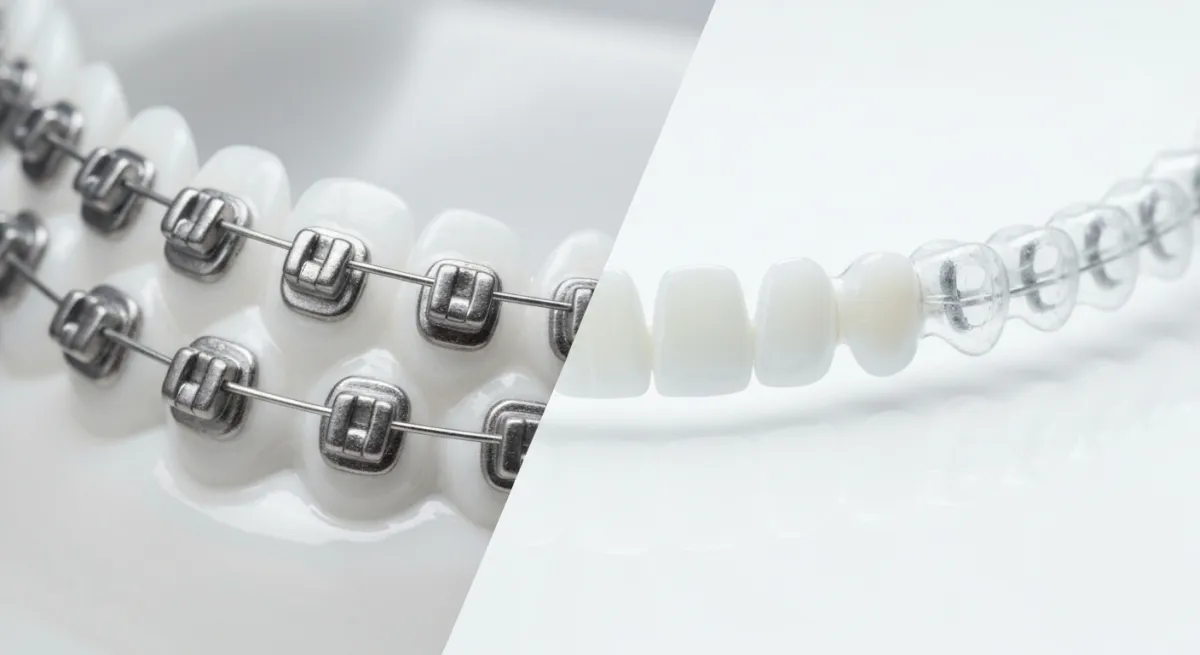
Visibility: Metal braces are highly visible. Ceramic braces are semi-visible with tooth-coloured brackets. Lingual braces are hidden behind teeth. Clear aligners are nearly invisible.
Cost (INR): Metal braces INR 25,000 – 60,000. Ceramic INR 40,000 – 80,000. Lingual INR 80,000 – 2,00,000. Clear aligners INR 1,00,000 – 4,00,000.
Comfort: Braces cause moderate discomfort from wires and brackets. Aligners are smooth and comfortable.
Removable: Braces are fixed. Aligners are removable for eating, brushing, and flossing.
Treatment Time: Braces typically 12-24 months. Aligners 6-18 months.
Food Restrictions: Braces require avoiding hard and sticky foods. Aligners have no food restrictions — just remove them before eating.
Effectiveness: Braces treat all cases including severe. Aligners work best for mild to moderate cases.
Compliance: Braces work 24/7 without patient effort. Aligners require disciplined wear of 20-22 hours daily.
What Are Braces? How Do They Work?
Types of Braces
Metal braces are the traditional, most affordable, and highly effective option for all cases. Ceramic braces use tooth-coloured brackets that are less visible but slightly more expensive. Self-ligating braces use clips instead of elastic bands, requiring fewer adjustments. Lingual braces are placed behind the teeth, making them completely hidden — the most expensive braces option.
How Braces Straighten Teeth
Brackets are bonded to each tooth and connected by an archwire. The wire applies constant, controlled pressure to move teeth gradually into position. Adjustments are made every 4-6 weeks by the orthodontist. Because they are fixed, braces work around the clock without relying on patient compliance.
What Are Clear Aligners? How Do They Work?
How Clear Aligners Work
A series of custom-made transparent plastic trays move your teeth incrementally — approximately 0.25 to 0.3mm per tray. You switch to a new tray every 1-2 weeks. Aligners must be worn 20-22 hours per day for the treatment to be effective. They are removed only for eating, brushing, and flossing.
How Samhita Dental Fabricates Aligners In-House
At Samhita Dental, digital impressions are taken (no messy moulds), a treatment plan is created using specialised software, and aligners are milled on-site using our in-house milling machine. This reduces cost by eliminating external lab fees, shortens turnaround time, and gives the dentist direct quality control over every tray.
Pros and Cons of Braces
Advantages
Lower cost — the most affordable orthodontic option at INR 25,000 – 60,000 for metal braces. Works for all cases — can treat severe crowding, complex bite issues, and significant rotations. No compliance needed — fixed to teeth, works 24/7 without patient effort. Proven track record with decades of clinical evidence. No risk of losing trays. Better for complex malocclusions that aligners cannot handle.
Disadvantages
Highly visible metal brackets and wires. Food restrictions — no hard, sticky, or crunchy foods. Discomfort after wire adjustments for 2-3 days. Harder to maintain oral hygiene — brushing and flossing around brackets is challenging. More frequent and longer clinic visits every 4-6 weeks. Emergency visits for broken wires or loose brackets. Typically longer treatment duration of 12-24 months.
Pros and Cons of Clear Aligners
Advantages
Nearly invisible — most people will not notice you are wearing them. Removable — take out for eating, brushing, and special occasions. More comfortable — smooth plastic with no wires or brackets to irritate cheeks. No food restrictions — eat whatever you want. Better oral hygiene — remove to brush and floss normally. Fewer clinic visits — shorter, less frequent appointments. Predictable results — digital treatment plan shows expected outcome before starting. Faster for mild cases — 6-10 months for minor corrections.
Disadvantages
Higher cost — INR 1,00,000 to 4,00,000, which is 2-5 times more than metal braces. Compliance dependent — results suffer if not worn 20-22 hours daily. Limited for complex cases — cannot treat severe crowding, complex rotations, or significant bite issues. Risk of losing trays — removable trays can be misplaced. Slight temporary lisp for the first 1-2 days with a new tray. Small tooth-coloured attachments may be bonded to teeth for additional grip.
Braces vs Aligners — Cost Comparison in Bangalore
Metal Braces: INR 25,000 – 60,000
Ceramic Braces: INR 40,000 – 80,000
Lingual Braces: INR 80,000 – 2,00,000
Clear Aligners (In-House, Samhita): INR 1,00,000 – 4,00,000
Clear Aligners (Invisalign): INR 2,50,000 – 5,00,000
Braces are the clear winner on upfront cost alone. But total cost should include hidden factors: emergency visits for broken wires, extended treatment duration, and retainer costs. Aligners have a higher upfront cost but fewer surprise expenses. Samhita Dental's in-house fabrication keeps aligner costs competitive, and EMI options are available for both braces and aligners. Read our full clear aligners cost guide for Bangalore for a detailed breakdown.
When Should You Choose Braces?
Braces are the better choice when you have severe crowding or complex bite issues (overbite, underbite, crossbite), when budget is a primary concern, when you are a teenager (compliance with removable aligners can be challenging at a young age), when you need significant tooth rotation or vertical movement, when you prefer a fixed approach with no daily compliance decisions, or when your dentist recommends braces based on clinical evaluation.
When Should You Choose Clear Aligners?
Clear aligners are the better choice when your case is mild to moderate, when aesthetics are important (working professional, social life, public-facing role), when you want the flexibility to remove them for meals and brushing, when you are disciplined enough to wear them 20-22 hours daily, when you are an adult seeking discreet orthodontic treatment, when you want faster results for mild corrections, and when you value comfort over cost savings.
Can You Switch from Braces to Aligners?
Yes, switching is possible in some cases but not ideal. Some patients start with braces for the initial heavy movement and transition to aligners for the finishing phase. Switching mid-treatment may extend duration and increase overall cost. The best approach is to get a thorough evaluation upfront and choose the right option from the start. Samhita Dental evaluates every patient for both options and recommends the best fit.