
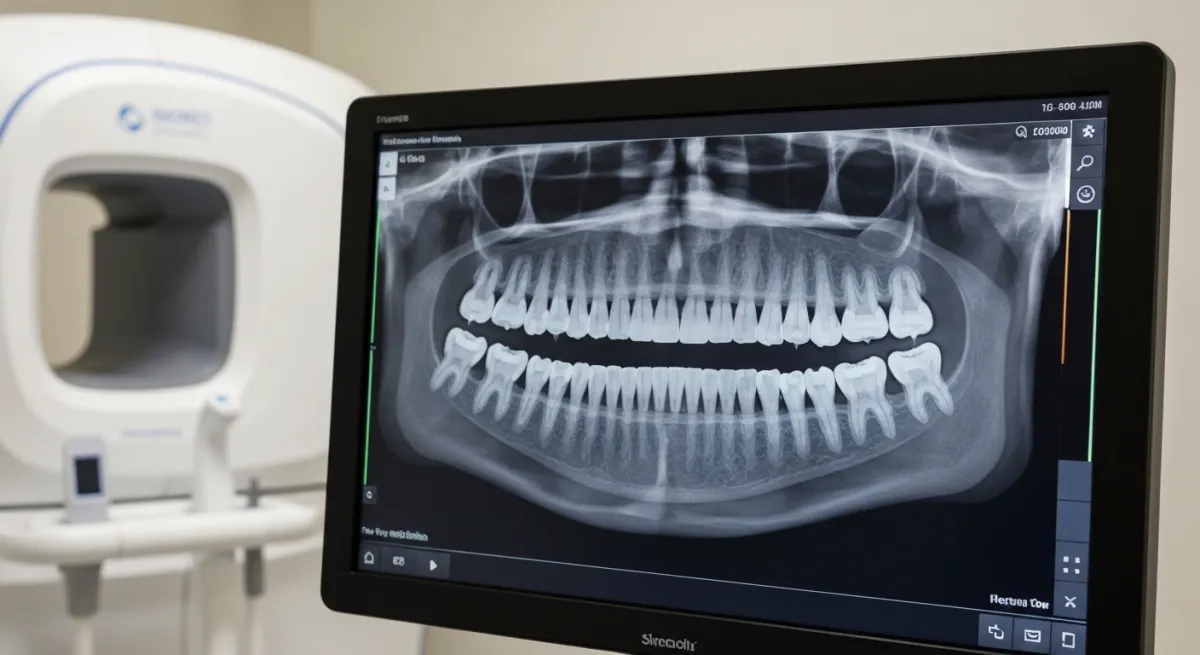
What Are Dental X-Rays?
Samhita Dental and Polyclinic in Basaveshwaranagar, Bangalore is equipped with in-house dental X-ray and diagnostic facilities, including both OPG (Orthopantomogram) and RVG (Radiovisiography) digital X-ray systems. This means you can get comprehensive dental imaging done right at our clinic without the inconvenience of visiting a separate diagnostic lab. Results are available instantly on our digital screens, allowing our dentists to diagnose and begin treatment without delay.
In-House X-Ray Advantage
Having diagnostic equipment within the dental clinic offers significant advantages for patients. You save time by avoiding separate trips to an external imaging centre. There is no waiting for reports as digital images appear on screen within seconds. Your dentist can position and adjust the X-ray in real time to get the most informative image. The images can be immediately discussed with you so you understand your diagnosis and treatment options. Having instant access to diagnostic imaging also means that emergency patients can be evaluated and treated faster, and treatment plans can be developed more accurately during a single appointment.
Types of Dental X-Rays (OPG vs RVG)
1. OPG (Orthopantomogram / Panoramic X-Ray): An OPG provides a single, wide-view image of the entire mouth, including all teeth, both jaws (upper and lower), the temporomandibular joints (TMJ), and surrounding structures such as the sinuses and nasal area. The procedure is quick and painless. You stand in front of the machine while the imaging arm rotates around your head, capturing the complete panoramic view in just 15 to 20 seconds. OPG X-rays are invaluable for: assessing overall dental health, planning orthodontic treatment, evaluating wisdom teeth position and impaction, planning dental implant placement, detecting jaw fractures and pathology, screening for cysts, tumours, and bone diseases, and assessing the extent of gum disease and bone loss.
2. RVG (Radiovisiography / Periapical Digital X-Ray): An RVG is a focused, high-resolution digital X-ray of one to three individual teeth and the surrounding bone. A small sensor is placed inside the mouth next to the tooth of interest, and the image is captured in just a few seconds. RVG provides detailed views of individual tooth structure, making it essential for: detecting cavities between teeth and beneath existing fillings, evaluating the health of tooth roots and surrounding bone, diagnosing the need for root canal treatment, monitoring healing after dental procedures, assessing the fit of crowns, bridges, and implants, and detecting infections and abscesses at the root tip.
OPG vs RVG Comparison:
Coverage: OPG captures the entire mouth in a single image, while RVG focuses on 1 to 3 teeth in high detail.
Duration: OPG takes 15 to 20 seconds; RVG takes 2 to 5 seconds per image.
Radiation dose: OPG delivers approximately 0.01 mSv; RVG delivers approximately 0.005 mSv per image. Both are extremely low.
Sensor placement: OPG is taken with the machine outside the mouth; RVG requires a small sensor to be placed inside the mouth.
Best used for: OPG is ideal for overall assessment, treatment planning, and screening. RVG is ideal for detailed examination of specific teeth and targeted diagnosis.
When to use: Most patients receive an OPG at their first visit for a comprehensive overview. RVGs are taken as needed to investigate specific areas in greater detail during treatment.
When Are Dental X-Rays Needed?
Dental X-rays are an essential diagnostic tool in many clinical situations. They are typically needed during initial dental examinations to establish a baseline record of oral health, when there is suspected decay that is not visible on examination, before root canal treatment to assess root anatomy and infection, for implant planning to evaluate bone density, height, and proximity to vital structures, during orthodontic assessment to understand tooth positions, root shapes, and jaw growth, to evaluate wisdom teeth for impaction and decide on extraction, after dental trauma to check for root fractures and bone damage, to monitor periodontal disease and bone loss, before and after surgical procedures, and for routine check-ups (typically once every 1 to 2 years for patients with good oral health).
Safety & Radiation
Dental X-rays are among the safest medical imaging procedures available. Digital X-rays, which are used at Samhita Dental, use 80 to 90 percent less radiation than traditional film-based X-rays. To put the radiation doses in perspective: a single RVG image delivers approximately 0.005 mSv of radiation, which is less than the radiation you receive from a few hours of natural background exposure. A single OPG delivers approximately 0.01 mSv, which is comparable to 1 to 2 days of natural background radiation. For comparison, a chest X-ray delivers about 0.02 mSv, and a CT scan of the head delivers about 2.0 mSv. We further minimise exposure by using lead aprons and thyroid collars for every patient, taking X-rays only when clinically necessary, and following the ALARA principle (As Low As Reasonably Achievable). Dental X-rays are safe for most patients, including children. However, as a precaution, we generally avoid taking X-rays during pregnancy unless absolutely necessary for an emergency.
Cost of Dental X-Rays
At Samhita Dental in Basaveshwaranagar, dental X-rays are very affordably priced. A single RVG X-ray costs between INR 100 and INR 300. An OPG (full mouth panoramic X-ray) costs INR 700. These prices are highly competitive, and the convenience of having the imaging done in-house with instant results provides excellent value. In many cases, the X-ray cost is included as part of the overall treatment fee.
How to Prepare for a Dental X-Ray
Dental X-rays require minimal preparation. There is no need to fast or make any special arrangements. Simply remove any jewellery, glasses, or metal objects from the head and neck area before the X-ray. Inform your dentist if you are pregnant or suspect you might be, so appropriate precautions can be taken. For an OPG, you will need to stand still for about 15 to 20 seconds while the machine rotates around your head. For an RVG, you will need to hold a small sensor in your mouth for a few seconds. Both procedures are painless and very quick.
Why Choose Samhita Dental for Dental X-Rays & Diagnostics?
At Samhita Dental and Polyclinic in Basaveshwaranagar, Bangalore, you receive diagnostic imaging from experienced dental specialists who prioritize your comfort and results.
- MDS Oral Surgeon on Staff — Dr. Sumukh M holds an MDS in Oral & Maxillofacial Surgery with 15+ years of experience
- 100% Sterilization — Autoclave sterilization with strict infection control protocols
- In-House Diagnostics — OPG and digital X-ray facilities for immediate diagnosis
- Transparent Pricing — every price published up front, with EMI options available
- Convenient Hours — Open 10 AM to 8 PM, Monday to Saturday
Book your appointment today by calling 7483578147 or booking online.
Frequently Asked Questions
1. Are dental X-rays safe?
Yes. Digital dental X-rays use extremely low levels of radiation, 80 to 90 percent less than traditional film X-rays. The doses are well within safe limits established by international health organisations.
2. How often do I need dental X-rays?
For patients with good oral health, a full set of X-rays every 1 to 2 years is typically sufficient. Patients undergoing treatment or those with higher risk of dental problems may need X-rays more frequently.
3. Can dental X-rays detect all dental problems?
Dental X-rays reveal a great deal, including cavities, bone loss, infections, and impacted teeth. However, some conditions are better assessed through clinical examination, so X-rays complement rather than replace a thorough dental check-up.
4. Are dental X-rays safe during pregnancy?
As a precaution, routine dental X-rays are usually postponed until after delivery. However, in a genuine emergency, dental X-rays can be taken with proper shielding (lead apron and thyroid collar) as the radiation dose is extremely low.
5. What is the difference between OPG and RVG?
OPG is a panoramic X-ray showing the entire mouth in one image. RVG is a focused X-ray showing 1 to 3 teeth in detail. Both are digital and provide instant results.
6. Do I need to go to a separate lab for dental X-rays?
No. Samhita Dental has both OPG and RVG equipment in-house. All imaging is done at the clinic with instant results.
7. Is the dental X-ray procedure painful?
No. Dental X-rays are completely painless. The only minor discomfort might be from holding the small RVG sensor in your mouth for a few seconds.
8. Can children have dental X-rays?
Yes. Dental X-rays are safe for children and are important for detecting cavities, assessing developing teeth, and planning orthodontic treatment. The radiation dose is minimal.
9. How long does it take to get dental X-ray results?
With our digital systems, images appear on screen within seconds. Your dentist can review and discuss the results with you immediately.
10. Why does my dentist need an X-ray if there is no pain?
Many dental problems, including cavities, bone loss, and infections, can develop without causing pain in their early stages. X-rays help detect these issues before they become symptomatic, allowing for simpler and less costly treatment.
Book an appointment today
Provide your contact details and get a call back from our team. You can also reach us on 7483578147