
What Are Dental Implants?
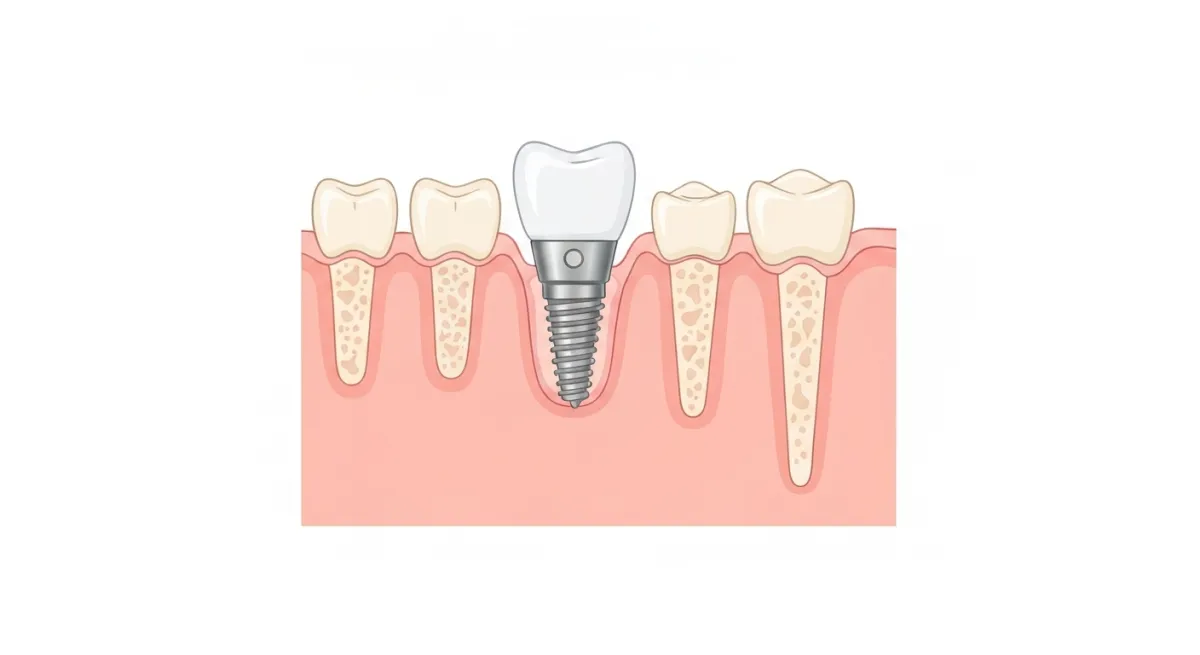
A dental implant is a titanium or zirconia post surgically placed into the jawbone to act as an artificial tooth root. Once the implant fuses with the bone through a natural process called osseointegration, a custom-made dental crown is attached to create a replacement tooth that looks, feels, and functions exactly like a natural tooth.
How Do Dental Implants Work?
Dental implants work by replacing the entire tooth structure — root and crown. The implant post (made of biocompatible titanium or zirconia) is placed into the jawbone, where it integrates with the surrounding bone over 3–6 months. An abutment (connector piece) is then attached, and a custom dental crown is fitted on top. The result is a permanent, stable tooth that preserves jawbone density, prevents adjacent teeth from shifting, and restores full chewing function.
Parts of a Dental Implant
- Implant Post (Root): A screw-shaped titanium or zirconia post placed into the jawbone. This acts as the artificial tooth root and can last a lifetime.
- Abutment (Connector): A small piece that connects the implant post to the dental crown. It is attached after osseointegration is complete.
- Dental Crown (Visible Tooth): A custom-made prosthetic tooth (zirconia, ceramic, or PFM) that looks and functions like a natural tooth. The crown typically lasts 10–15 years before needing replacement.
Unlike removable dentures, dental implants are permanent and do not slip or require adhesives. Unlike dental bridges, implants do not require grinding down adjacent healthy teeth for support. Dental implants are recommended by dental associations worldwide as the gold standard for tooth replacement.
Why Choose Samhita Dental for Dental Implants in Bangalore?
Dr. Sumukh M — MDS Oral Surgeon & FICOI
At Samhita Dental, your dental implant is placed by Dr. Sumukh M — one of the most qualified implantologists in West Bangalore:
- MDS in Oral & Maxillofacial Surgery (A.J Institute, 2014) — a 3-year post-graduate surgical specialisation. Dr. Sumukh is a surgical specialist, not just a general dentist.
- 15+ years of clinical experience (since 2009)
- 500+ workshops conducted on dental implants and oral surgery for other dentists — Dr. Sumukh trains the dentists who train your dentist.
- Assistant Professor, Oral & Maxillofacial Surgery at Rajarajeshwari Medical College — actively teaching the next generation of oral surgeons.
Advanced Technology for Precise Implant Placement
- Computer-guided implant placement — uses 3D imaging (CBCT) to plan the exact position, angle, and depth of each implant before surgery. Higher accuracy, shorter procedures, better outcomes.
- In-house OPG and Digital X-Ray — all diagnostics done on-site. No need to visit a separate radiology centre.
- In-house laser — for precision soft tissue work during implant procedures.
Transparent Pricing — No Hidden Costs
Samhita Dental is one of the very few clinics in Bangalore that publishes dental implant pricing on its website. Starting at INR 36,000 per implant — the price quoted is the price you pay. No hidden charges.
Types of Dental Implants — Which One Is Right for You?
Different clinical situations require different implant approaches. At Samhita Dental, Dr. Sumukh evaluates each case and recommends the implant type that will deliver the best long-term results.
Endosteal Implants (Most Common)
The most widely used implant type. A screw-shaped titanium post is placed directly into the jawbone. Requires adequate jawbone density. Suitable for single tooth, multiple teeth, or as anchors for bridges and dentures. Highest success rate (98%+).
Subperiosteal Implants
Placed under the gum but on top of the jawbone (not drilled into bone). Used when the patient does not have enough jawbone and cannot undergo bone grafting. Less common than endosteal; typically used for patients who cannot wear conventional dentures.
Basal Implants
Placed in the basal (cortical) bone — the dense outer layer of the jaw that does not resorb. Major advantage: can often be done without bone grafting even in patients with severe bone loss. Faster treatment timeline — teeth within 3–5 days in some cases.
Zygomatic Implants
Long implants anchored in the zygomatic bone (cheekbone) instead of the upper jawbone. Used when the upper jaw has severe bone loss and cannot support conventional implants. Eliminates the need for sinus lift surgery.
Mini Dental Implants
Smaller diameter than standard implants. Used to stabilise lower dentures or in areas with limited bone width. Less invasive placement and faster healing. Lower cost but also lower load-bearing capacity.
| Type | Bone Requirement | Treatment Time | Best For | Approx. Cost (INR) |
|---|---|---|---|---|
| Endosteal | Adequate jawbone | 3–6 months | Single/multiple teeth | From 36,000 |
| Subperiosteal | Low bone density | 2–4 months | Patients who can't have endosteal | Consultation required |
| Basal | Severe bone loss OK | 3–5 days | Quick restoration, bone loss | Consultation required |
| Zygomatic | Severe upper jaw loss | 1–2 days loading | Upper jaw rehabilitation | Consultation required |
| Mini | Limited bone width | 1–2 months | Denture stabilisation | Consultation required |
At Samhita Dental, Dr. Sumukh M, an FICOI-certified implantologist, evaluates each case and recommends the implant type that will deliver the best long-term results.
Our Implant Procedure
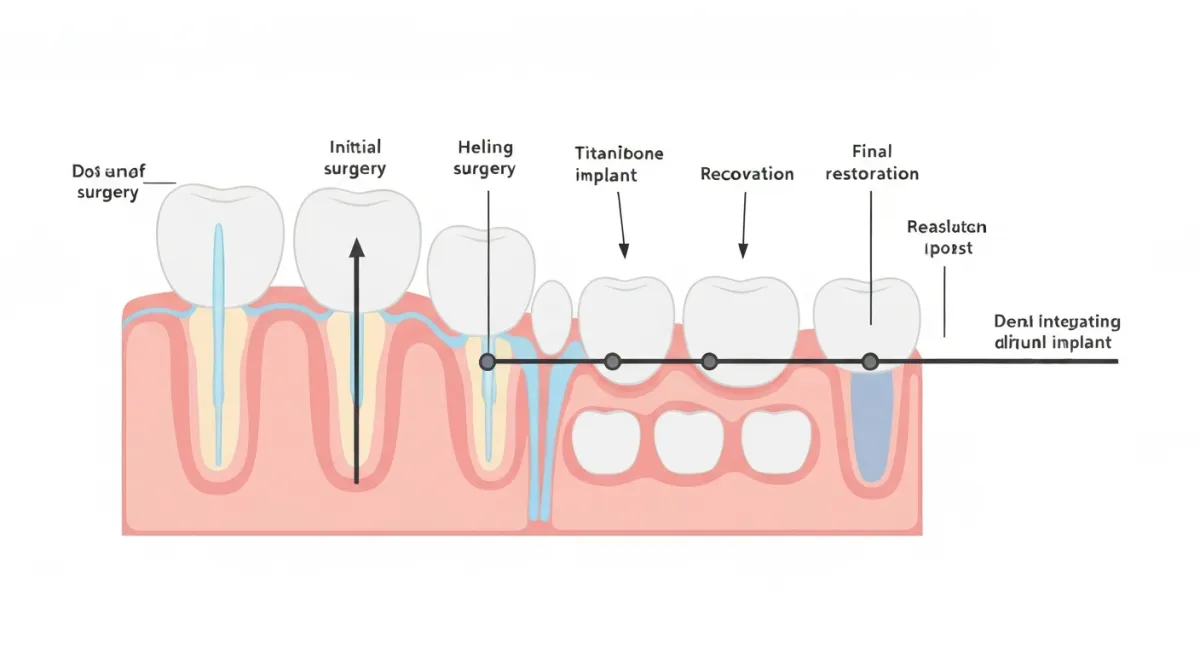
Dental implant placement at Samhita Dental follows a carefully planned, phased approach:
Phase 1 — Consultation and Planning: A thorough oral examination is conducted, including an OPG X-ray and, if needed, a CBCT scan to evaluate bone density, bone height, and proximity to vital structures such as nerves and sinuses. A detailed treatment plan is created, including implant positioning, crown design, and cost estimate.
Phase 2 — Implant Placement: Under local anaesthesia, the titanium implant is surgically placed into the jawbone at the precise angle and depth determined during planning. The procedure takes 30 to 60 minutes per implant. Computer-guided placement ensures accuracy and minimises surgical trauma.
Phase 3 — Osseointegration: Over the next 3 to 6 months, the implant fuses with the surrounding bone in a process called osseointegration. During this healing period, a temporary restoration may be provided so you can eat and smile normally.
Phase 4 — Abutment and Crown: Once osseointegration is complete, an abutment (connector) is placed on top of the implant, and a custom-made crown is fabricated and attached. The final crown is designed to match the colour, shape, and size of your natural teeth for a seamless appearance.
In cases where tooth extraction is needed before implant placement, our oral surgeon can often place the implant immediately after extraction, reducing the overall treatment timeline.
Dental Implant Cost in Bangalore — Transparent Pricing
Samhita Dental is one of the very few clinics in Bangalore — and the only one in Basaveshwaranagar — that publishes dental implant pricing on its website. We believe in transparent pricing with no hidden costs.
Dental Implant Price List at Samhita Dental
| Implant Type | Price Range (INR) | What's Included |
|---|---|---|
| Single Tooth Implant | From 36,000 | Implant post + abutment + crown |
| Two Implants | 36,000 – 60,000 | Per tooth pricing applies |
| All-on-4 (per arch) | Consultation required | Full arch rehabilitation |
| All-on-6 (per arch) | Consultation required | Full arch rehabilitation |
| Full Mouth (both arches) | Consultation required | Complete oral rehabilitation |
| Same-Day Implant | From 36,000 | Same-day placement + temporary crown |
Note: Final pricing depends on the implant brand (Nobel Biocare, Straumann), crown material (zirconia, ceramic, PFM), number of implants, and any additional procedures (bone grafting, sinus lift). Dr. Sumukh provides an exact cost estimate during your consultation — with no hidden charges.
What Affects Dental Implant Cost?
- Implant brand — Premium brands (Nobel Biocare, Straumann) cost more but have better long-term outcomes
- Crown material — Zirconia crowns cost more than PFM but look more natural
- Number of implants — More implants = higher total cost
- Additional procedures — Bone grafting, sinus lift, or tooth extraction before placement
EMI payment options are available to make implant treatment accessible for all patients.
Dental Implant Recovery Timeline & Aftercare
| Period | What to Expect | Care Instructions |
|---|---|---|
| Day 1–3 | Mild swelling, slight discomfort | Soft foods, ice pack, prescribed painkillers, no forceful rinsing |
| Day 4–7 | Swelling subsides, stitches dissolve | Gentle warm salt water rinses, soft foods, avoid smoking |
| Week 2–3 | Gums healing, temporary crown in place | Semi-soft foods, gentle brushing around implant site |
| Month 1–3 | Osseointegration progressing | Normal brushing and flossing, avoid biting hard objects |
| Month 3–6 | Osseointegration complete | Regular dental check-up to confirm healing |
| 6 Months+ | Final crown fitted — treatment complete | Brush, floss, visit dentist every 6 months |
Aftercare Tips for Long-Lasting Implants
- Brush twice daily with a soft-bristled toothbrush
- Floss daily — implants can develop peri-implantitis if plaque accumulates
- Avoid smoking — the #1 risk factor for implant failure
- Avoid biting extremely hard objects (ice, bottle caps)
- Visit Samhita Dental every 6 months for professional teeth cleaning and implant check-up
- The implant screw can last a lifetime; the crown may need replacement after 10–15 years
Why Choose Samhita Dental for Dental Implants?
At Samhita Dental and Polyclinic in Basaveshwaranagar, Bangalore, you receive dental implant treatment from experienced dental specialists who prioritize your comfort and results.
- MDS Oral Surgeon on Staff — Dr. Sumukh M holds an MDS in Oral & Maxillofacial Surgery with 15+ years of experience
- 100% Sterilization — Autoclave sterilization with strict infection control protocols
- In-House Diagnostics — OPG and digital X-ray facilities for immediate diagnosis
- Transparent Pricing — every price published up front, with EMI options available
- Convenient Hours — Open 10 AM to 8 PM, Monday to Saturday
Book your appointment today by calling 7483578147 or booking online.
Single Tooth Dental Implant — Replace One Missing Tooth
A single tooth implant is the most common implant procedure. One implant replaces one missing tooth without affecting the adjacent healthy teeth. Unlike a dental bridge, which requires grinding down the teeth on either side of the gap, a single implant stands independently in the jawbone.
A single tooth implant preserves jawbone density at the site of the missing tooth, preventing the bone resorption that occurs when a tooth is lost and not replaced. The implant crown is custom-made to match the colour, shape, and size of your surrounding teeth, making it indistinguishable from a natural tooth.
Single Tooth Implant vs Dental Bridge
| Factor | Single Tooth Implant | Dental Bridge |
|---|---|---|
| Adjacent teeth affected | No — standalone replacement | Yes — healthy teeth filed down for support |
| Jawbone preservation | Yes — stimulates bone like a natural root | No — bone resorbs under the pontic |
| Lifespan | Implant screw: lifetime; crown: 10–15 years | 5–15 years before replacement needed |
| Cleaning | Normal brushing and flossing | Special floss threader required |
| Cost at Samhita Dental | From INR 36,000 | INR 4,000–12,000 per unit |
At Samhita Dental, a single tooth implant costs from INR 36,000 depending on the implant brand and crown material selected. This includes the implant post, abutment, and crown — no hidden charges.
All-on-4 & All-on-6 Dental Implants — Full Arch Replacement
All-on-4 is a revolutionary technique where an entire arch of teeth (upper or lower) is supported by just four strategically placed implants. All-on-6 uses six implants for added stability and is recommended for patients with higher bite force or lower bone density. Both techniques provide a full set of fixed, non-removable teeth that look and function naturally.
These solutions are ideal for patients who have lost all or most of their teeth in one jaw and want a permanent alternative to removable dentures. The implants are angled to maximise contact with available bone, often eliminating the need for bone grafting even in patients with moderate bone loss. Temporary teeth can be fitted on the same day as implant placement.
All-on-4 vs All-on-6 Comparison
| Factor | All-on-4 | All-on-6 |
|---|---|---|
| Implants per arch | 4 | 6 |
| Bone requirement | Moderate | Moderate to low |
| Stability | High | Very high |
| Same-day teeth | Yes — temporary prosthesis | Yes — temporary prosthesis |
| Best for | Most full-arch cases | Higher bite force, lower bone density |
For patients missing teeth in both jaws, full mouth dental implants using All-on-4 or All-on-6 in both arches provide complete oral rehabilitation. Implant-supported overdentures — where 2–4 implants per jaw support a removable denture that snaps on — offer a more affordable alternative with greater stability than traditional dentures.
Same-Day Dental Implants — New Teeth in a Single Visit
Same-day dental implants, also called immediate implants, allow the implant to be placed immediately after tooth extraction in the same appointment. A temporary crown is fitted the same day, so you leave the clinic with a tooth rather than a gap. This eliminates the waiting period between extraction and implant placement, preserving bone and gum tissue at the extraction site.
Not every patient qualifies for same-day implants. Requirements include adequate bone density at the extraction site, no active infection, and good general health. Dr. Sumukh's MDS in Oral & Maxillofacial Surgery makes him uniquely qualified to assess candidacy and perform immediate placement safely.
Note: Same-day refers to placing the implant and a temporary crown in one visit. The permanent crown is fitted after osseointegration is complete (3–6 months), ensuring long-term stability and success.
Dental Implant Brands — Straumann & Nobel Biocare
Samhita Dental uses premium, internationally recognised implant brands with decades of clinical research behind them.
Nobel Biocare Implants
Nobel Biocare is the world's leading dental implant manufacturer with over 50 years of research and clinical evidence. Their TiUnite surface technology promotes faster osseointegration.
Straumann Implants
Straumann is a Swiss implant system with one of the highest documented success rates in the world (over 99% in clinical studies). Their SLActive surface promotes faster bone healing — osseointegration in 3–4 weeks compared to 6–8 weeks with standard surfaces. The Roxolid material (titanium-zirconium alloy) is stronger than pure titanium, allowing smaller-diameter implants in areas with limited bone width.
| Feature | Nobel Biocare | Straumann |
|---|---|---|
| Country of origin | Switzerland | Switzerland |
| Research history | 50+ years | 60+ years |
| Surface technology | TiUnite | SLActive |
| Osseointegration time | 6–8 weeks | 3–4 weeks (SLActive) |
| Success rate | 98%+ | 99%+ |
| Material options | Titanium, Zirconia | Titanium, Roxolid (Ti-Zr) |
Dental Implant Materials — Titanium vs Zirconia
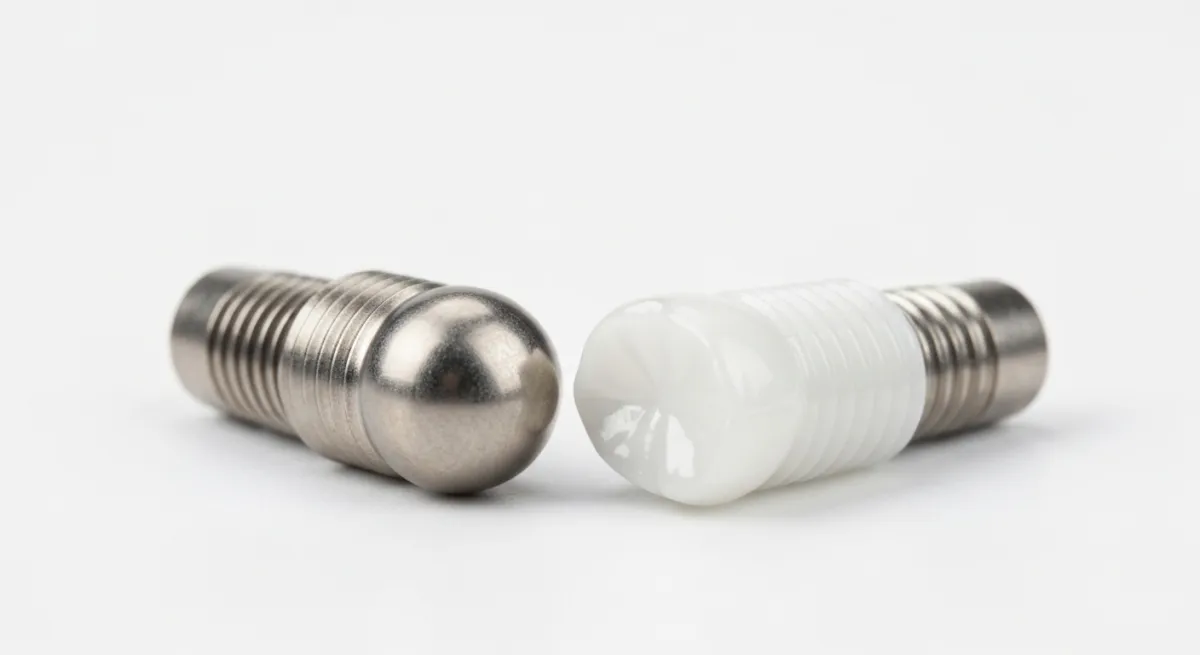
Titanium Implants — The Gold Standard
Titanium has been used in implant dentistry for over 50 years and is the most researched and proven implant material. It is extremely strong, durable, and has the highest long-term success rates (98%+). Available in pure titanium (Grade IV) and titanium alloys like Straumann's Roxolid (Ti-Zr), titanium implants are the most affordable and widely used option.
Zirconia (Ceramic) Implants — The Metal-Free Alternative
Zirconia implants are a metal-free option for patients with metal sensitivities or aesthetic concerns. They are white and tooth-coloured, so there is no grey line visible at the gum margin — a cosmetic advantage for front teeth. Zirconia is biocompatible and hypoallergenic but has a shorter clinical track record (15+ years) and higher cost than titanium.
| Property | Titanium | Zirconia (Ceramic) |
|---|---|---|
| Track record | 50+ years | 15+ years |
| Strength | Very high | High |
| Aesthetics | Grey (may show at gum line) | White (matches natural teeth) |
| Metal-free | No | Yes |
| Success rate | 98%+ | 95–97% |
| Best for | Most patients | Front teeth, metal sensitivity |
Dental Implants vs Bridges vs Dentures — Which Is Best?
Choosing between implants, bridges, and dentures is one of the most common decisions patients face when replacing missing teeth.
| Factor | Dental Implants | Dental Bridge | Dentures |
|---|---|---|---|
| Longevity | 15–25 years (screw: lifetime) | 5–15 years | 5–7 years |
| Jawbone preservation | Yes — stimulates bone | No — bone resorbs | No — accelerates bone loss |
| Adjacent teeth | Not affected | Healthy teeth filed down | Not affected |
| Stability | Fixed, permanent | Fixed (cemented) | Removable, can slip |
| Eating ability | All foods | Most foods | Restricted (hard, sticky foods) |
| Maintenance | Brush and floss normally | Special floss threader | Remove daily for cleaning |
| Cost per tooth (Samhita) | From INR 36,000 | INR 4,000–12,000/unit | Varies |
| 20-year total cost | Lowest (no replacement) | Medium (1–2 replacements) | Medium (3–4 replacements) |
Dental implants are the only tooth replacement option that preserves the jawbone. While implants have a higher upfront cost, they are often the most economical choice over 20 years. However, bridges are a good option when adjacent teeth already need crowns, and dentures may be preferred when budget is a primary concern or medical conditions prevent surgery.
Am I a Good Candidate for Dental Implants?
Most adults with missing teeth are good candidates for dental implants. Ideal candidates have adequate jawbone density, healthy gums, and good general health. Certain conditions require special consideration but are not necessarily disqualifiers:
- Diabetes: Controlled diabetes patients can receive implants successfully. Uncontrolled diabetes increases infection risk.
- Bone loss: Bone grafting can rebuild the jawbone. Alternatively, basal or zygomatic implants can be placed without bone grafting.
- Smoking: Increases implant failure risk. Dr. Sumukh recommends quitting at least 2 weeks before and 8 weeks after surgery.
- Age: There is no upper age limit — healthy patients in their 70s and 80s receive implants successfully. Minimum age is 18.
Not sure if dental implants are right for you? Book a free implant assessment with Dr. Sumukh. He will evaluate your jawbone density using in-house OPG X-ray and recommend the best solution.
How Long Do Dental Implants Last?
With proper care, the titanium implant screw can last a lifetime. The dental crown attached to the implant typically lasts 10–15 years before needing replacement due to normal wear. This makes dental implants the longest-lasting tooth replacement available — far outlasting bridges (5–15 years) and dentures (5–7 years).
Factors that affect implant longevity include oral hygiene habits, smoking status, overall health, and regular dental check-ups. At Samhita Dental, we recommend visiting every six months for a professional teeth cleaning and implant check-up.
Full Mouth & All-on-4 Dental Implant Cost in Bangalore
Full mouth dental implants in Bangalore typically cost from INR 4,50,000 for both arches, while All-on-4 (full fixed teeth on one arch) ranges from INR 2,50,000 to INR 4,50,000 per arch — the exact figure depends on the implant brand, the prosthesis material (titanium-base acrylic vs full zirconia), and whether bone grafting is needed. At Samhita Dental in Basaveshwaranagar, every full-arch plan is quoted transparently by Dr. Sumukh M (MDS Oral Surgeon, FICOI) after a clinical evaluation and OPG/CBCT scan.
| Treatment | Implants | Typical Range (INR) | Material Note |
|---|---|---|---|
| Single Tooth Implant | 1 | From 36,000 / tooth | Titanium post + crown; zirconia higher |
| All-on-4 (per arch) | 4 per arch | 2,50,000 – 4,50,000 | Acrylic/titanium bridge; full zirconia higher |
| All-on-6 (per arch) | 6 per arch | 3,00,000 – 5,00,000+ | Added stability for higher bite force / lower bone density |
| Full Mouth (both arches) | 8–12 total | From 4,50,000 | Zirconia full-arch bridges priced higher |
These ranges are typical for Bangalore and are confirmed only after consultation — they are not a fixed promise. Your quote includes the implants, abutments, the fixed full-arch bridge prosthesis, and a same-day temporary set of teeth in suitable cases; extractions, bone grafting, or sinus lift may add to the total. Full-arch work is part of our wider full mouth rehabilitation programme. To make treatment manageable, EMI and no-cost instalment options are available, so the cost can be spread over several months rather than paid upfront. See indicative figures on our pricing page, then book an appointment with Dr. Sumukh for an exact, personalised estimate with no hidden charges.
Dental Implants — Frequently Asked Questions
Related Articles
Learn more about this treatment and oral health from our blog
Book an appointment today
Provide your contact details and get a call back from our team. You can also reach us on 7483578147