
Wisdom Tooth Removal Cost in Bangalore
Wisdom tooth removal in Bangalore typically costs INR 3,000 to INR 8,000 per tooth, depending on how the tooth is positioned. A simple, fully-erupted wisdom tooth starts from around INR 3,000, a surgically impacted tooth ranges from INR 4,000 to INR 8,000, and complex bony-impacted cases or extractions done under IV sedation can go up to INR 10,000. At Samhita Dental and Polyclinic in Basaveshwaranagar, every wisdom tooth is removed by Dr. Sumukh, an MDS Oral & Maxillofacial Surgeon, so even difficult impactions are handled in-house without a referral. The exact figure is confirmed only after an OPG X-ray and clinical examination.
Wisdom teeth (third molars) are the last teeth to erupt, usually between the ages of 17 and 25. Because the modern jaw is often too small to accommodate them, they frequently get stuck, grow at an angle, or only partially emerge — a condition known as impaction. When this happens, removal is one of the most common oral surgery procedures performed worldwide, and it is precisely the area an oral and maxillofacial surgeon trains for years to master.
What Is a Wisdom Tooth and Why Is Removal Needed?
A wisdom tooth is the third and final molar in each corner of the mouth, giving most adults four in total. When there is enough space and the tooth erupts straight and cleanly, it may never need to be removed. Problems begin when the tooth lacks room to come through properly. It may then press against the neighbouring molar, push through the gum at an angle, or remain trapped beneath the gum and bone.
Removal is recommended when a wisdom tooth causes pain, infection, decay, or threatens the health of the teeth and bone around it. Leaving a problematic wisdom tooth in place can lead to recurring gum infections (pericoronitis), decay in the adjacent second molar, cyst formation, and crowding. Because wisdom teeth sit so far back, they are extremely difficult to clean, which makes them prone to cavities and gum disease even when they appear to have erupted normally. In many cases, an early, planned extraction is far simpler and more comfortable than an emergency removal once infection has set in.
Signs You May Need Your Wisdom Tooth Removed
Not every wisdom tooth needs to come out, but the following signs strongly suggest that an evaluation — and often extraction — is needed:
- Pain or pressure at the back of the jaw, often a dull ache that comes and goes or worsens when biting.
- Red, swollen, or bleeding gums over a partially erupted tooth, sometimes with a bad taste or odour caused by trapped food and bacteria.
- Difficulty opening the mouth fully or pain when swallowing, which can indicate infection spreading around the tooth.
- Recurring gum flap infection (pericoronitis) — the gum over a half-erupted wisdom tooth repeatedly swells and becomes tender.
- Decay or a cavity in the wisdom tooth or the molar in front of it, which a filling alone cannot reliably save.
- Crowding or shifting of the front teeth as the wisdom tooth pushes forward.
- Cysts or jaw swelling detected on an X-ray around an unerupted tooth.
If you are experiencing facial swelling, fever, or severe pain that stops you from eating or sleeping, treat it as urgent and seek emergency dental care rather than waiting. Our in-house digital OPG X-ray lets us see the full position of the tooth and its roots in minutes.
Types of Wisdom Tooth Impaction
The difficulty, time, and cost of removal depend largely on how the tooth is impacted. Understanding the type helps explain why two patients can be quoted very different prices. Dr. Sumukh classifies each case after reviewing the X-ray:
Soft-Tissue Impaction
The crown of the wisdom tooth has broken through the bone but is still partly covered by gum tissue. The gum flap traps food and bacteria, causing repeated infection. These are usually the most straightforward impactions to treat, often requiring only a small incision in the gum.
Partial (Partially Erupted) Impaction
Part of the tooth has emerged into the mouth while the rest remains trapped under gum or bone, frequently tilted against the second molar. Because the tooth is half-exposed, it is very prone to decay and gum infection. Removal may involve sectioning the tooth into pieces for easier, gentler extraction.
Bony (Full Bony) Impaction
The entire tooth is encased within the jawbone and has not erupted at all. These are the most complex cases — they require removing a small amount of bone and often dividing the tooth before it can be lifted out. Bony impactions, especially those close to the lower jaw nerve, are exactly where the training of an MDS oral and maxillofacial surgeon matters most for a safe, predictable result.
The Wisdom Tooth Removal Procedure, Step by Step
Knowing what to expect makes the procedure far less daunting. Here is exactly how a wisdom tooth extraction is carried out at Samhita Dental:
Step 1: Examination and OPG X-Ray
Dr. Sumukh examines the tooth and takes a digital OPG (panoramic) X-ray to assess the angle of impaction, the shape and number of roots, and the proximity to the inferior alveolar nerve in the lower jaw or the sinus in the upper jaw. This planning step is what makes the surgery safe and predictable.
Step 2: Local Anaesthesia
The area around the tooth is thoroughly numbed with local anaesthesia. You will feel a brief pinch from the injection, after which the tooth, gum, and surrounding bone become completely numb. You stay fully awake but feel no pain during the procedure — only mild pressure.
Step 3: IV Sedation (Optional)
For anxious patients, multiple extractions in one sitting, or deep bony impactions, IV (intravenous) sedation can be added. Under sedation you remain in a deeply relaxed, drowsy state and typically remember little of the procedure, while still breathing on your own. This option is discussed and planned in advance.
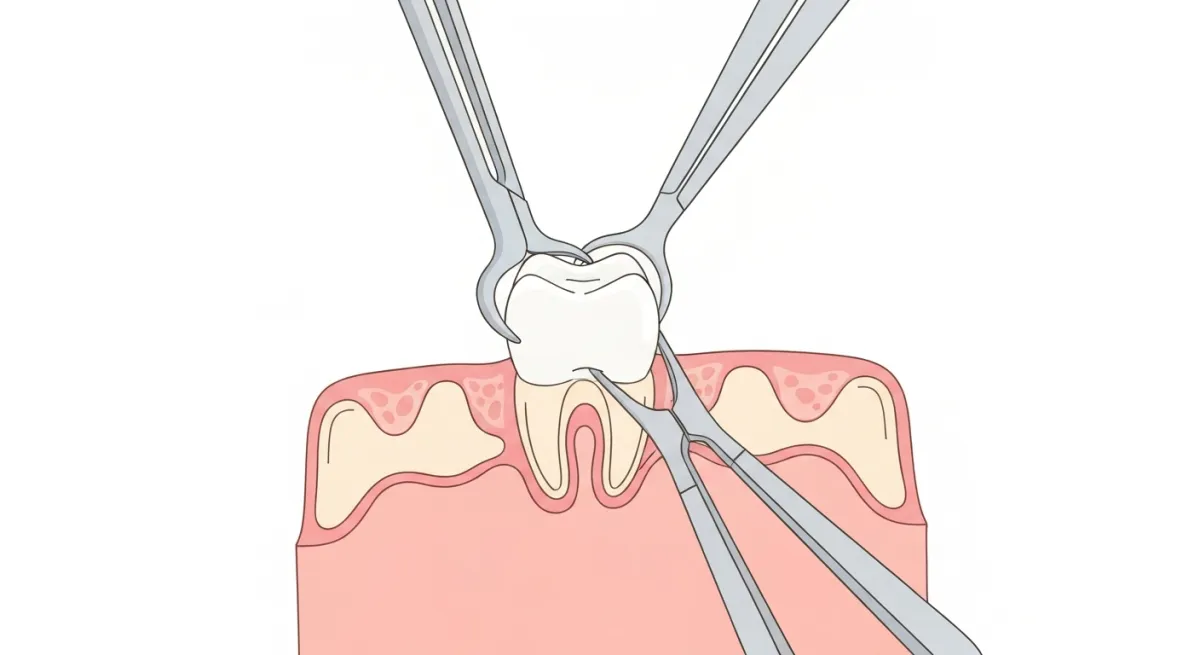
Step 4: Accessing and Removing the Tooth
If the tooth is impacted, a small incision is made in the gum to expose it. A minimal amount of bone covering the tooth may be removed, and the tooth is often divided into sections so it can be lifted out through a smaller opening. This sectioning technique reduces trauma, protects the surrounding bone and nerve, and speeds healing.
Step 5: Cleaning and Stitches
The socket is cleaned of any debris or infected tissue, and the site is irrigated. Dissolvable or removable stitches are placed where needed to help the gum heal. A gauze pad is then placed over the socket and you are asked to bite down gently to control bleeding and encourage a healthy blood clot to form.
A simple extraction may take 15–20 minutes, while a bony impaction can take 30–45 minutes. You can usually go home shortly afterwards, ideally with someone to accompany you if sedation was used.
Wisdom Tooth Removal Cost by Case Complexity
Pricing is driven almost entirely by how the tooth is positioned. The table below shows the typical ranges at Samhita Dental in Basaveshwaranagar; your exact cost is confirmed after the OPG X-ray and examination.
| Case Type | Description | Typical Cost (INR) |
|---|---|---|
| Simple wisdom tooth extraction | Fully erupted, normal position, straightforward removal | 3,000 – 4,000 |
| Soft-tissue / surgical impaction | Covered by gum, small incision needed | 4,000 – 6,000 |
| Partial bony impaction | Tilted or partly under bone, tooth sectioned | 5,000 – 8,000 |
| Full bony impaction | Fully encased in bone, complex surgical removal | 6,000 – 10,000 |
| IV sedation (add-on) | For anxiety or multiple/complex extractions | Additional, quoted on assessment |
| OPG X-ray | Panoramic imaging for diagnosis and planning | ~500 |
These are typical ranges rather than a fixed promise — the final figure depends on the number of roots, the angle of impaction, proximity to nerves, and whether sedation is chosen. We keep our pricing transparent with no hidden charges, and Dr. Sumukh will give you a clear, written estimate before any treatment begins. To get an exact quote for your case, book an appointment for an examination.
Recovery and Aftercare: Preventing Dry Socket
Most patients recover comfortably within a few days. Careful aftercare in the first 24–72 hours is the single most important factor in avoiding complications, especially a painful condition called dry socket (alveolar osteitis), which occurs when the protective blood clot in the socket is dislodged too early. Follow these instructions closely:
- Bite gently on the gauze for 30–45 minutes after surgery to help a firm blood clot form, and replace it if bleeding continues.
- Do not rinse, spit forcefully, or use a straw for the first 24 hours. The suction and pressure can dislodge the clot and cause dry socket.
- Avoid smoking and alcohol for at least 48–72 hours — smoking is one of the biggest causes of dry socket and significantly delays healing.
- Apply a cold compress to the cheek in 15-minute intervals on the first day to reduce swelling, which usually peaks around day two or three.
- Eat soft, cool foods such as curd, dal, khichdi, soup, and smoothies for the first few days, and chew on the opposite side.
- Take prescribed painkillers and antibiotics exactly as directed. Mild pain, swelling, and slight jaw stiffness are normal for two to three days.
- Begin gentle warm salt-water rinses from the day after surgery to keep the area clean, but swish softly rather than vigorously.
- Keep brushing the rest of your teeth, taking care to avoid the extraction site for the first day or two.
Contact the clinic promptly if you develop severe throbbing pain three to four days after surgery (a classic sign of dry socket), bleeding that will not stop, increasing swelling, fever, or difficulty swallowing. These are easily managed when treated early. In rare cases where a wisdom tooth is removed alongside a damaged neighbouring molar, your surgeon may discuss whether a root canal can save that adjacent tooth or whether it will eventually need replacement with a dental implant.
Why an MDS Oral & Maxillofacial Surgeon Matters
Wisdom tooth removal — particularly of impacted and bony cases — is core to the speciality of oral and maxillofacial surgery. At many general clinics, complex impactions are referred out; at Samhita Dental, they are managed in-house by Dr. Sumukh, who holds an MDS in Oral & Maxillofacial Surgery, and FICOI certification. This specialist training matters for several reasons:
- Safety around the nerve. Lower wisdom teeth sit close to the inferior alveolar nerve. A surgeon trained to read 3D positioning and use precise sectioning techniques minimises the risk of nerve injury and numbness.
- Less trauma, faster healing. Experience with impacted teeth means smaller incisions, conservative bone removal, and a gentler procedure — which translates to less swelling and a quicker recovery for you.
- Confident management of complications. Should anything unexpected arise, a maxillofacial surgeon is equipped to handle it on the spot, including under IV sedation.
- One place for the whole journey. From diagnosis to removal to any future tooth replacement, your care stays under one experienced team.
For routine, non-impacted cases, you can also read about our general approach to tooth extraction. Whatever your situation, the first step is a proper diagnosis. With a 4.9 rating from over 400 Google reviews and clinic hours of Monday to Saturday, 10 AM to 8 PM, Samhita Dental makes it convenient to get your wisdom teeth assessed and treated in Basaveshwaranagar.
Wisdom Tooth Removal — Frequently Asked Questions
Book an appointment today
Provide your contact details and get a call back from our team. You can also reach us on 7483578147